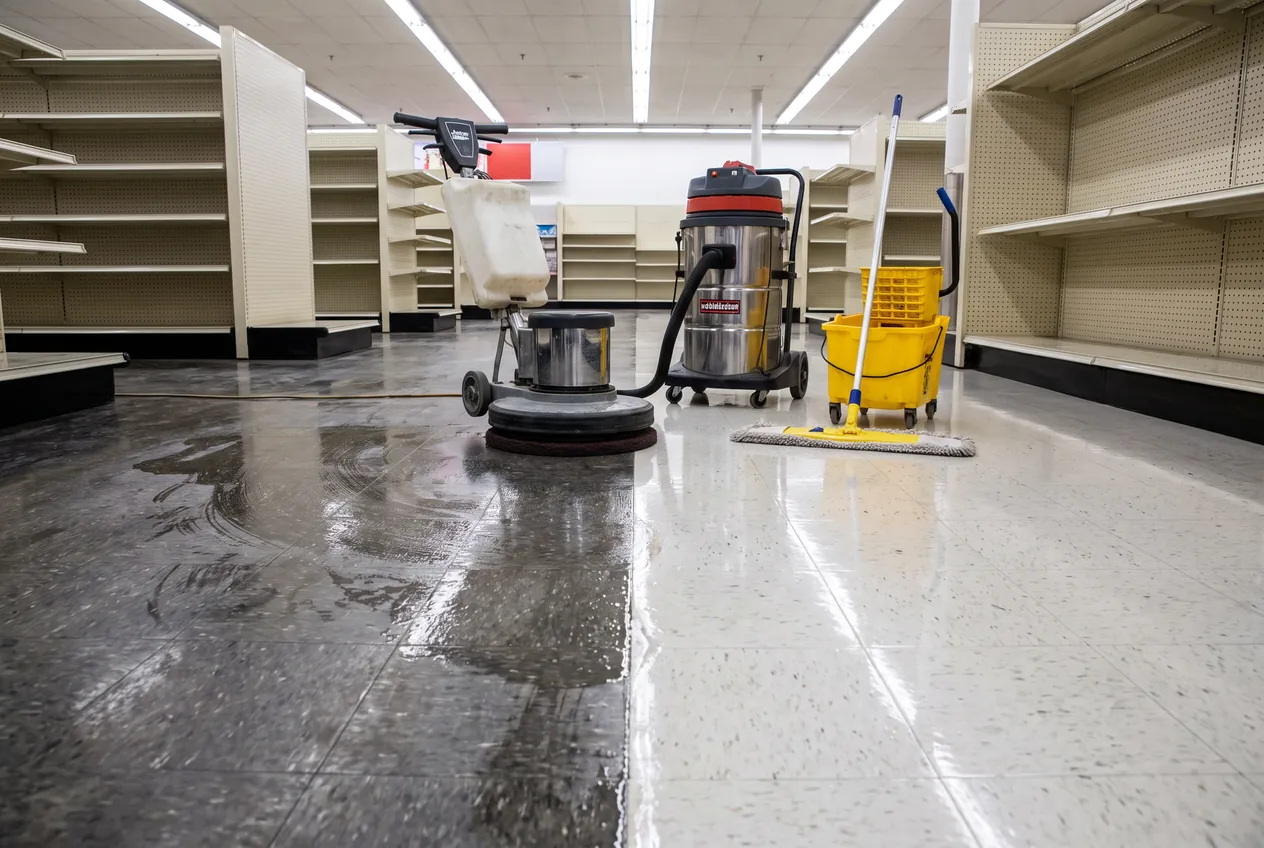
What strip and wax means today
The phrase is older than the products. Nobody puts paste wax on a commercial floor anymore; the wax in strip and wax is an acrylic floor finish that dries to a hard, glossy layer. The floor it goes on most often is VCT, the vinyl composition tile found in break rooms, corridors, retail aisles and school hallways. VCT is porous without finish, so the coating is what protects it and gives it shine.
Over time the finish scratches, yellows and traps dirt between layers. Mopping cannot reach that grime because it is sealed inside the coating. Stripping chemically breaks the old finish down so it can be removed entirely, leaving bare tile that takes fresh coats evenly.
The process, step by step
Stripping takes time since every stage depends on the one before it being complete. Rushing the rinse or the drying time is where most bad results come from: finish laid over stripper residue will not bond, and coats applied too thick or too soon stay soft and scuff easily.
| Step | What happens | Why it matters |
|---|---|---|
| Clear and dust mop | Furniture moves out and loose grit is removed | Grit under the pad scratches tile |
| Signs and prep | Wet floor signs go up, baseboards and doorways are protected | Stripper is slippery and can splash walls |
| Apply stripper and dwell | Solution spreads in sections and sits | Dwell time does most of the work |
| Scrub | Low-speed machine with a stripping pad loosens the finish | Breaks old coats down to bare tile |
| Pick up slurry | Wet vacuum removes the dissolved finish | Slurry left behind redeposits as it dries |
| Rinse and neutralize | Clean water rinse, often twice, plus neutralizer | Leftover stripper stops new finish from bonding |
| Dry | Floor dries completely | Trapped moisture clouds the finish |
| Apply finish | Several thin coats with drying time between | Thin coats cure hard; thick ones stay soft |
| Burnish (optional) | High-speed machine polishes the cured finish later | Raises gloss and tightens the surface |
Floors you should not strip
Stripping chemicals and aggressive pads are made for VCT and similar tile. Many newer floors are not built for them, and stripping one can void its warranty or ruin its factory wear layer. Before anyone books the job, find the floor maker's care guidance, or ask the building owner for the product name if you lease the space.
When nobody knows what the floor is, ask the provider to identify it during the walkthrough and to test a small, out-of-the-way spot before treating the whole room. One wrong product choice on a premium floor can cost more to fix than the strip and wax itself.
- Many luxury vinyl tile and plank products
- No-wax sheet vinyl and other floors sold as finish-free
- Any floor whose manufacturer warns against stripping
- Floors still under an installer warranty, until the terms are checked
How often: full strip versus scrub and recoat
Most floors do not need a full strip every few months. Between strips, crews do a scrub and recoat: they scrub off only the worn top layer of finish with a less aggressive pad, rinse, and add fresh coats. It refreshes the surface with far less labor and chemical use, and it leaves the base coats in place.
How often to fully strip depends on traffic. Many buildings strip once a year, and busier floors such as lobbies, grocery aisles and cafeterias may need it twice a year. Regular dust mopping, damp mopping with a neutral cleaner and periodic burnishing all stretch the time between strips.
What affects the cost of stripping and waxing
Strip and wax work is usually priced by area, but the figure moves with the condition of the floor and the work around it. When you compare quotes, ask each provider how many coats of finish are included and whether moving furniture is part of the price or billed on top.
- Total square footage and how the space is broken up
- Layers of old finish built up since the last strip
- Furniture, shelving or equipment that has to move
- Number of finish coats and whether burnishing is included
- After-hours or weekend scheduling
- Edges, corners and baseboards that need hand work
Timing strip and wax in Kansas City
Ice melt and road salt get tracked in from December through March here, and that residue attacks floor finish and leaves a white film on tile. Stripping in the middle of winter means the new coats take that abuse right away. That is why many Kansas City buildings book floor work in early spring, once salt season is over and before spring storms start pushing mud into entries.
Because of fumes, slip risk and drying time, the job almost always happens after hours or across a weekend. Hot summer weather with heavy humidity can slow drying, so ask the provider how they handle ventilation and airflow if the work falls in the middle of summer.