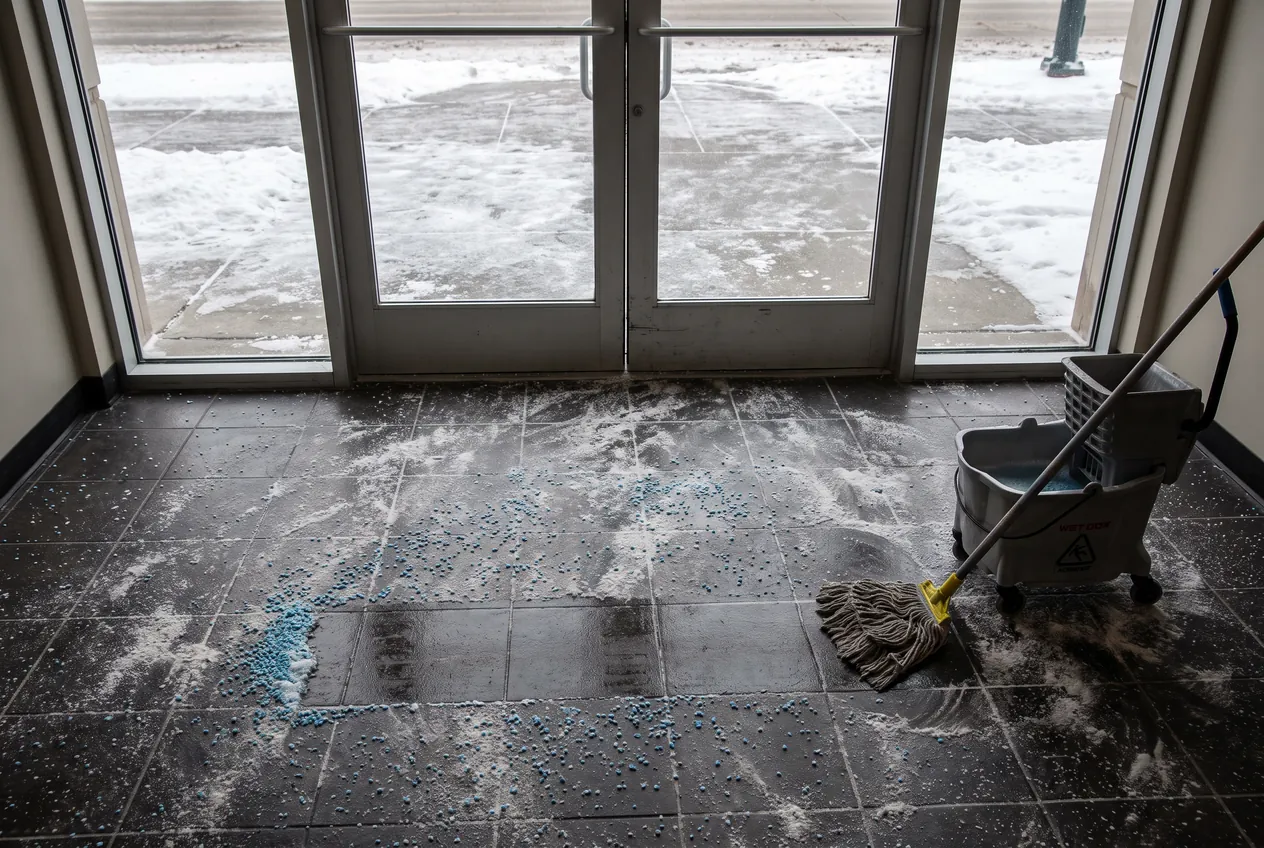
What salt and ice melt do to floors
Rock salt and calcium or magnesium chloride ice melts work by dissolving into a brine. When that brine dries on a floor, it leaves a white film. On resilient tile, the film dulls the finish and wears into it, so the floor looks hazy even after mopping. On any hard surface, the residue makes floors slippery, especially when snow melts off shoes and wets it again.
Carpet shows it differently. Salt wicks into the fibers and dries as pale rings and tide lines near doors, and those marks come back after vacuuming because the salt is still in the pile. Each day the residue sits, foot traffic grinds more of it in.
Start at the door with a matting system
Most of the salt that ends up in a building can be stopped in the first few steps inside. A matting system works in stages: an outdoor scraper mat knocks off slush and crystals, then indoor wiper mats absorb the moisture and fine residue. The indoor mats need to be long enough for several steps, because one short mat fills up fast and starts spreading brine instead of catching it.
- Outdoor scraper mat at every public entrance
- Indoor wiper mats long enough for several steps
- Mats at loading docks and staff doors too
- Mats vacuumed daily and swapped when saturated
- Mat edges kept flat so nobody trips
The daily routine during salt season
Daily attention matters more than one big cleanup at the end of winter. Dry salt crystals act like sandpaper underfoot, and every hour they stay on the floor they wear the finish down. A routine that removes them before they dissolve keeps the whole job small.
| Task | How often | Why |
|---|---|---|
| Dust mop or vacuum entries | Daily, more on storm days | Removes dry crystals before they get wet again |
| Damp mop with a neutral or ice-melt residue cleaner | Daily at entries | Light moisture lifts the film; flooding spreads it |
| Vacuum and rotate mats | Daily | Saturated mats push residue inside |
| Auto scrub large entries and lobbies | Several times a week in heavy weather | Picks up the dirty solution instead of leaving it |
| Spot treat carpet salt rings | As they appear | Keeps rings from setting before extraction |
| Carpet extraction at entries | As needed in winter, again in spring | Pulls salt from deep in the pile |
Removing residue from hard floors
Strong general cleaners are the wrong answer to the white film and can wear down floor finish on their own. A neutral cleaner, or a product made specifically to remove ice-melt residue, breaks the film down without attacking the coating. Apply it with a well-wrung mop, let it work briefly, then pick it up. Flooding the floor only dissolves the salt and carries it into grout lines and under baseboards.
For large lobbies and corridors, an auto scrubber does the job better than a mop because it scrubs and vacuums the solution up in one pass, leaving nothing to dry back into a film. On tile with grout, rinse after cleaning so residue does not settle in the joints.
Getting salt rings out of carpet
Vacuuming lifts loose crystals but leaves the dissolved salt behind. For rings and tide lines, a residue remover applied to the spot, followed by hot water extraction, pulls the salt out of the pile instead of pushing it deeper. Entry carpet and walk-off areas usually need extraction during the season and a full extraction once the weather turns.
Kansas City's salt season and the spring reset
In Kansas City, ice melt and salt come in on shoes from December through March, and spring storms follow right behind with mud at entries and loading areas. The floors get little rest between the two. Plan winter floor care as one stretch that runs from the first freeze until the spring rains ease, rather than reacting storm by storm.
Once salt season ends, resilient floors need a scrub and recoat to replace the finish the winter wore away, and many local buildings book it for early spring. Carpet near entries gets a full extraction at the same time. Getting both on the calendar before winter is over keeps the floors from carrying salt damage into summer.
Mistakes that make salt damage worse
Most winter floor damage comes from a few habits rather than one big storm. Watch for these during the season and correct them early, because a skipped step shows up later as worn finish and stained carpet that a spring cleanup cannot fully reverse.
- One short mat at a busy entrance
- Mopping with too much water
- Using a cleaner that is not neutral or made for ice-melt residue
- Letting dry salt sit on the floor overnight
- Skipping the loading dock and staff entrances
- Waiting until summer to refinish winter-damaged tile